

Ruemmler-Epstein Emails Raise Fresh Questions About CIA Torture Report
To: Jeffrey E. "John Brennan gave me the CIA Agency Medal"

Of the 11,000+ emails sent between Katheryn Ruemmler and Jeffrey Epstein, this is a needle in a haystack. It’s from Ruemmler to Epstein: “John Brennan gave me the CIA Agency Medal (the CIA’s hig=est award) this morning.”
Why did Obama’s top legal advisor receive the CIA’s highest award — just a few months after departing from the Administration?
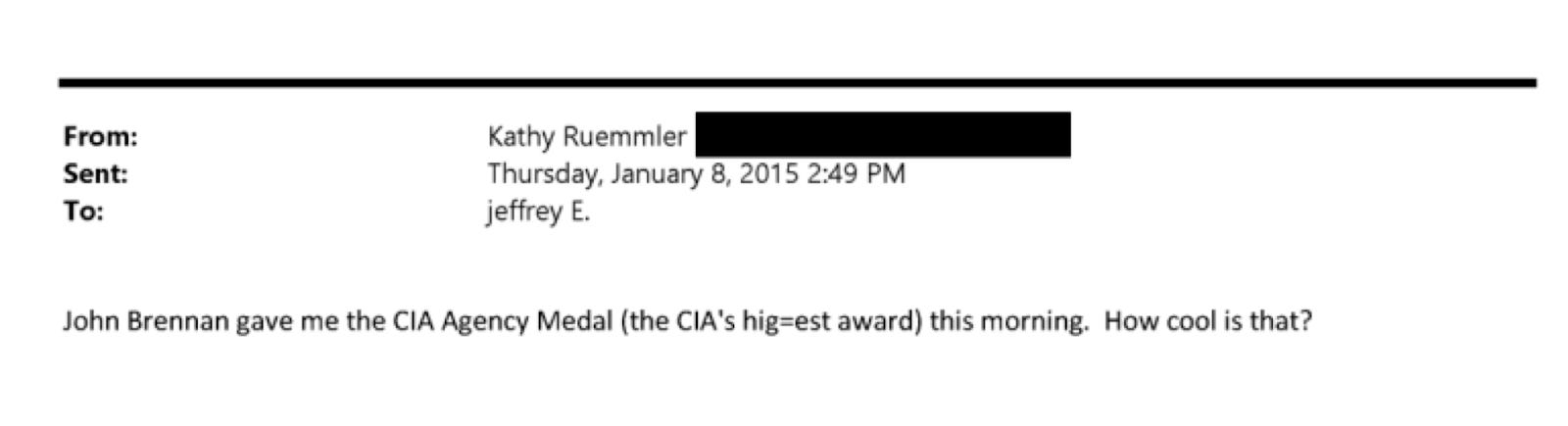
https://www.justice.gov/epstein/files/DataSet%2011/EFTA02386175.pdf
Ruemmler was the black sheep of Obama’s inner circle. She didn’t know him from Chicago, she wasn’t a champion of progressive populism, she was a federal prosecutor — with highly educated insider parents who worked on classified nuclear projects. Ruemmler’s presence in the administration puzzled Washington insiders and politicos, but her rise to become his top legal advisor in 2011 was unthinkable.
Kathy Ruemmler’s job was amorphous. The White House counsel provides legal advice to the President and Vice President in an official capacity — they are not the president’s personal attorney. Ruemmler’s day-to-day likely involved a wide range of work: heading inter-departmental negotiations, answering policy questions, resolving ethical dilemmas or concerns relating to constitutional law, overseeing lawyers at the Office of the White House Counsel, or fielding communications as the White House contact for the Department of Justice (DOJ).
Before her departure from the White House, Ruemmler found herself in the middle of one of the biggest controversies in CIA history: a public reckoning with the agency’s use of torture. Senator Dianne Feinstein, Chair of the Intelligence Committee, led an investigation into the CIA’s “terrorist detention and interrogation operations,” and the use of “enhanced techniques.”
On the morning of March 11, 2014, Feinstein delivered a speech on the Senate floor outlining CIA misconduct and a recent cover-up at the direction of the White House. The CIA Director at the time was John Brennan (2013-2017), presumably the same John Brennan who awarded Ruemmler the CIA’s highest honor months later.
Feinstein addressed the CIA’s destruction of videotapes of the early interrogations where “enhanced techniques” were used. She then explained that former CIA Director, Michael Hayden (2006-2009), assured the committee this was “not destruction of evidence as detailed records of the interrogations existed on paper.” That was not true. The Senator revealed that the Intelligence Committee obtained internal CIA documents detailing those interrogations, which were far worse than the agency attested was the extent of the program.
This speech would be the first time Senator Feinstein publicly addressed the controversy. She tried to settle the dispute in private, but broke her silence after two major stories engulfed the press: 1) that the CIA was allegedly spying on the Senate’s investigators, and 2) that the intelligence committee stole internal documents from the CIA.
The California Senator likely chose to deliver her remarks on the Senate floor for a reason: floor speeches by members of Congress are protected speech. The Debate/Speech clause of the Constitution (Article I Section 6) allows legislators to speak freely on matters of public concern with immunity from prosecution or lawsuits.
Feinstein cleared up allegations that the Senate’s investigators hacked CIA computers: yes, the committee obtained documents that the CIA apparently intended to keep internal, but it did so legally.
On several occasions, CIA personnel were surprised the committee had access to certain documents — Feinstein was unaware if they were shared unintentionally, or intentionally by a whistleblower. The internal files did not detail new information on the use of torture. What made them unique is the acknowledgement of CIA wrongdoing. The documents have been dubbed the “Internal Panetta Review,” named after Leon Panetta’s secret internal review of the CIA’s torture program. Leon Panetta served as Director of the CIA from 2009-2011.
The Senator confirmed what the press insinuated regarding the CIA’s intrusion into the oversight investigation. The committee lost access to 870 pages of documents without explanation. When pressed, the CIA explained that the documents were removed from committee computers at the direction of the White House.
Despite floor speeches being legally protected, Senators rarely share the details of White House meetings publicly. Yet, Feinstein described paying a visit to the White House, and scolding the White House counsel on the severity of interfering with an official Congressional investigation.
Feinstein followed this revelation with another, one that may have been new information for Kathy Ruemmler: despite the CIA and the White House’s efforts to revoke access to the documents, investigators still had them. They made both digital and physical copies, as is standard with the committee’s oversight process.
The scathing speech ignited outrage over the CIA’s use of torture, and the attempts by the White House and CIA to hide it.
Here’s Senator Dianne Feinstein, in her own words:
(Read Full Video Transcripts at end of article.)
Immediately after the Senator’s floor speech ended, Kathy Ruemmler rushed over to the Hart Building with Dennis McDonough (Obama’s chief of staff), to meet Feinstein at her office. We don’t know much about what happened next. Reuters’ reporting in March 2014 was vague: Ruemmler attempted to deescalate the tensions between the CIA and the Senate panel.
McDonough, Ruemmler, and Feinstein had a closed-door meeting, according to a Senate aide who spoke with Newsweek at the time. The aide shared no details as to what was said. (If anyone has information as to the contents of this meeting, my signal is @kaburbank.77)
About two months later, on June 2, 2014, Kathy Ruemmler left the White House. Shortly after, she was in contact with Jeffrey Epstein.
June 23, 2014 is Ruemmler’s first known contact with Jeffrey Epstein. He received a one-line email from his assistant, Lesley Geoff. It reads: “Please call Kathy Ruemmler on her cell.”
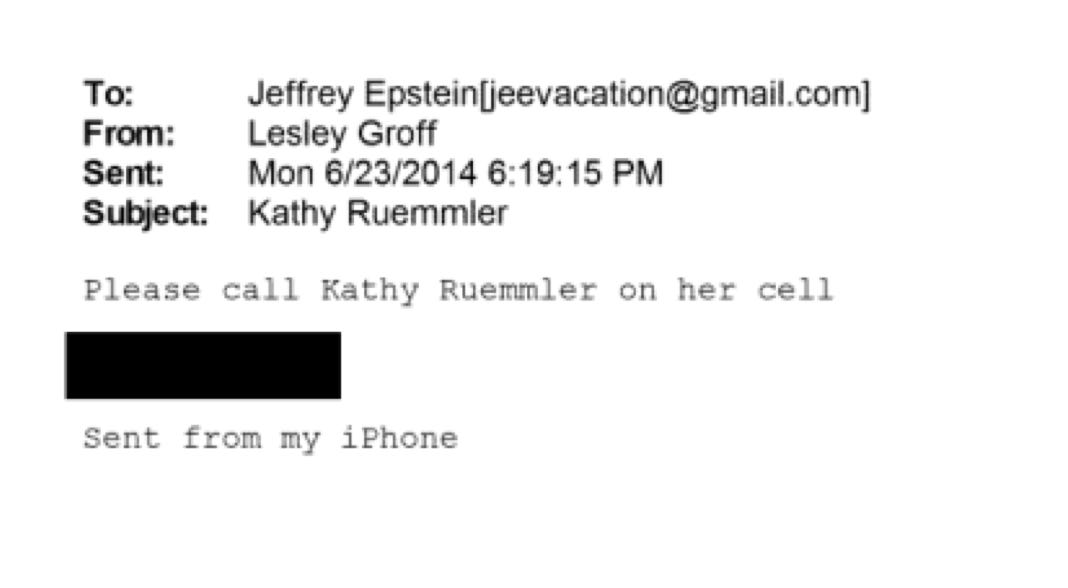
https://www.justice.gov/epstein/files/DataSet%2010/EFTA01916940.pdf
After reviewing emails and files of communication on and around June 23, 2014, it is unclear how Ruemmler first got in touch with Epstein and his assistant.
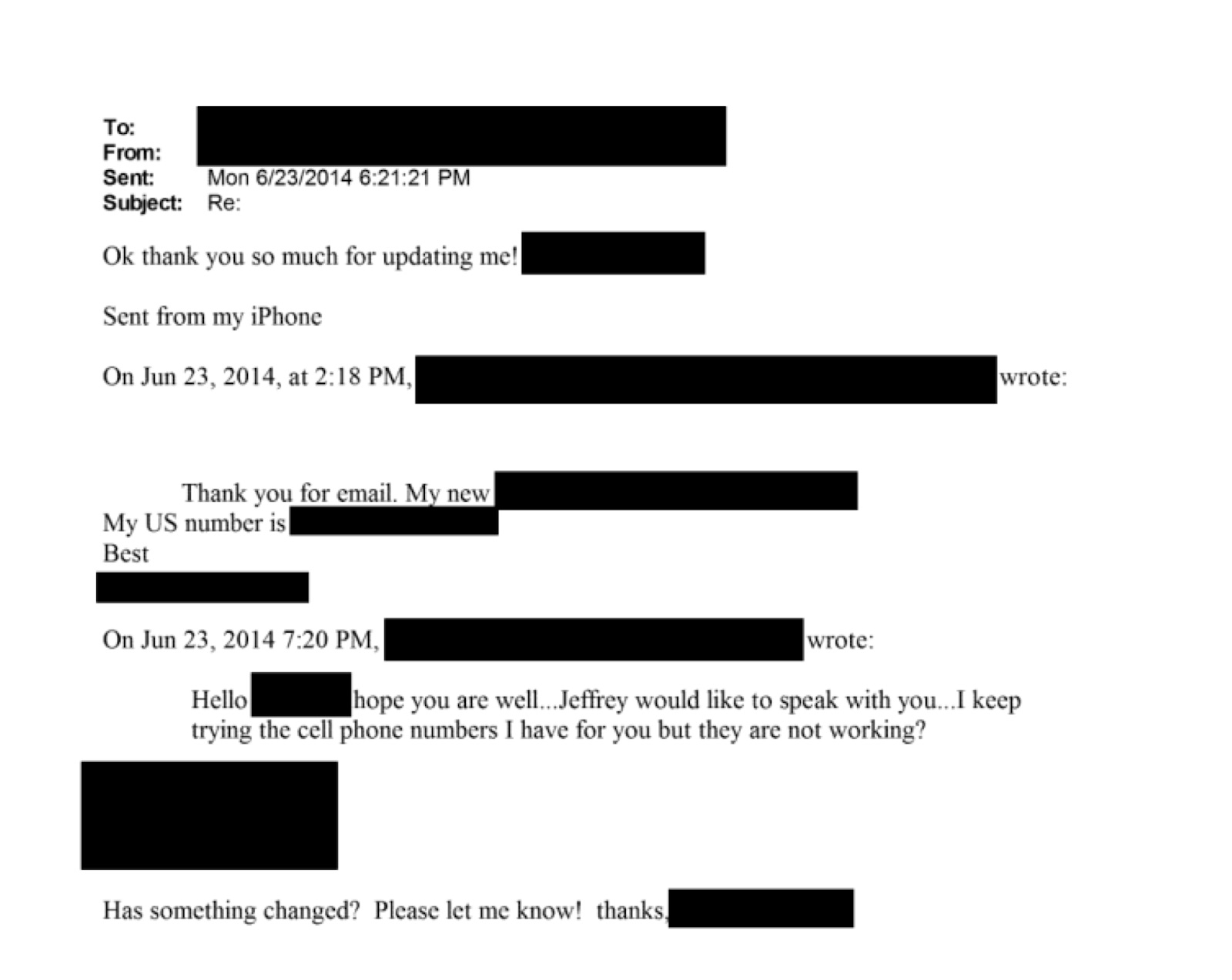
https://www.justice.gov/epstein/files/DataSet%2010/EFTA02103807.pdf
Ruemmler and Epstein set up a meeting only 21 days after she left Obama’s White House.
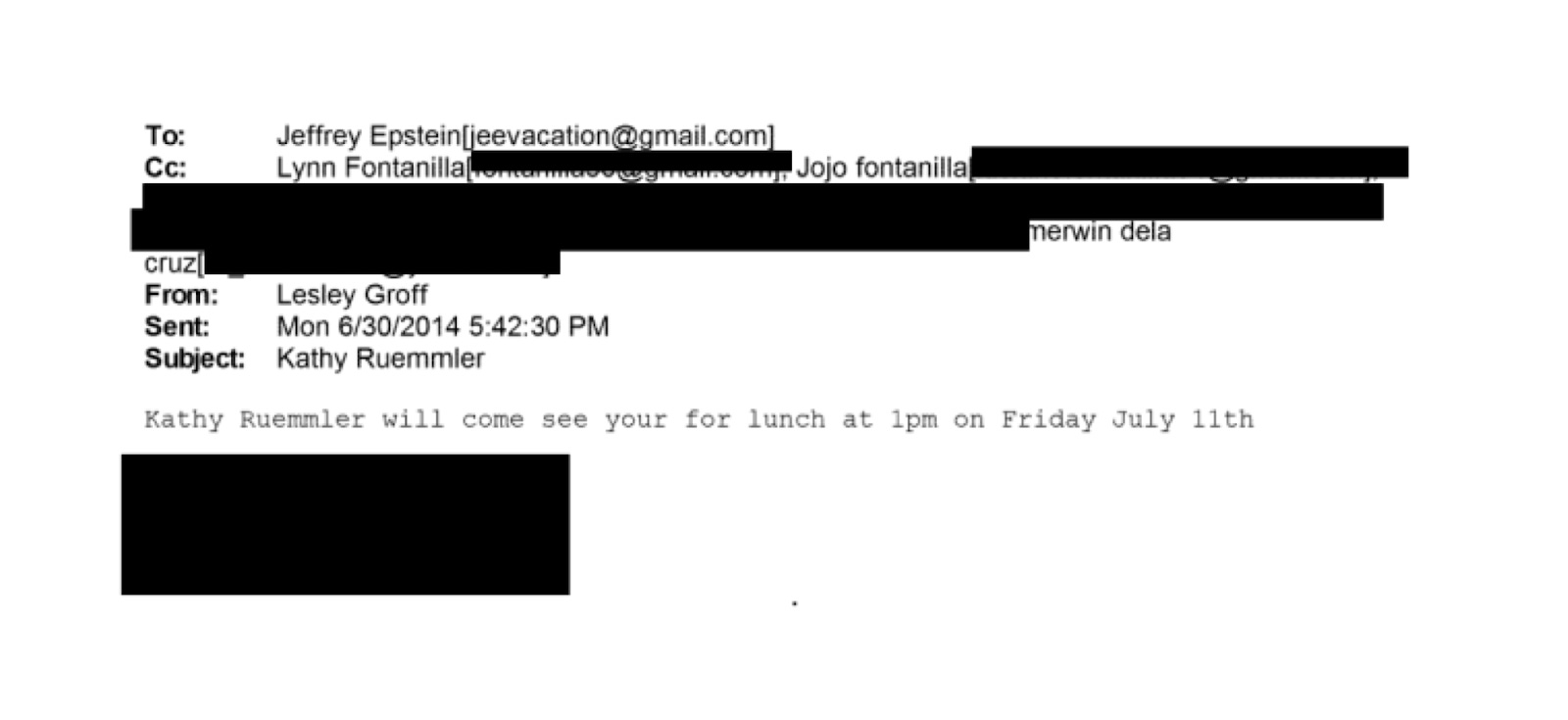
https://www.justice.gov/epstein/files/DataSet%2010/EFTA01920260.pdf
Ruemmler and Epstein met frequently, and in person. In the coming months and years, he would schedule her spa treatments, pay for her hair appointments, book her trips, and send flowers and birthday gifts. Ruemmler would console Epstein when his reputation tanked, and evidently discuss limiting how much Russian intelligence Obama should share with Trump.
On December 9, 2014, a summary of the Senate Intelligence Committee’s 6,000+ page report on CIA torture was made public. The oversight study was completed on December 15, 2014. As of today, Friday, February 13, 2026, the url where the study was published appears to have been taken down.
On January 8, 2015, just three weeks after the report was released, Ruemmler apparently received the CIA’s highest award from John Brennan, the same man who Directed the CIA while Ruemmler used her sway as White House counsel to cover up the agency’s torture program.
On Thursday, February 12, 2026, Ruemmler announced her resignation from Goldman Sachs. However, reading beyond the headlines reveals the resignation date is not effective until four months from now, on June 30, 2026.
In a perfect rhyme with recent history of alleged CIA spying on Senate oversight investigators reviewing documents on torture in 2014, this week’s Capitol controversy revolves around the DOJ tracking Members’ of Congress search history of the unredacted Epstein files.
Feinstein Floor Speech Transcript:
“Over the past week, there have been numerous press articles written about the Intelligence Committee’s oversight review of the detention and interrogation program of the CIA. Specifically, press attention has focused on the CIA’s intrusion and search of the Senate committee’s computers, as well as the committee’s acquisition of a certain internal CIA document, known as the Panetta review.
I rise today to set the record straight and to provide a full accounting of the facts and history. Let me say upfront, that I come to the Senate floor reluctantly. Since January 15, 2014 when I was informed of the CIA’s search of this committee’s network. I’ve been trying to resolve this dispute in a discreet and respectful way. I have not commented in response to media requests for additional information on this matter, however the increasing amount of inaccurate information circulating now cannot be allowed to stand unanswered.
The origin of this study: the CIA’s detention and interrogation program began operations in 2002, though it was not until September, 2006, that members of the intelligence committee, other than the chairman and the vice chairman were briefed. In fact, we were briefed by then CIA director Hayden, only hours before President Bush disclosed the program to the public. A little more than a year later, on December 6, 2007, a New York Times article revealed the troubling fact that the CIA had destroyed videotapes of some of the CIA’s first interrogations, using so-called “enhanced techniques.” We learned that this destruction was over the objections of President Bush’s White House counsel, and the director of national intelligence. After we read about the tapes — of the destruction — in the newspapers, Director Hayden briefed the Senate intelligence committee.
He assured us that this was not destruction of evidence as detailed records of the interrogations existed on paper, in the form of CIA operational cables, describing the detention conditions and the day-to-day CIA interrogations. The CIA director stated that these cables were, “a more than adequate representation,“ of what would have been on the destroyed tapes. Director Hayden offered at that time, during Sen. J Rockefeller’s chairmanship of the committee, to allow members or staff review the sensitive CIA operational cables. Given that the video tapes had been destroyed. Shairman Rockefeller sent two of his committee staffers out to the CIA on nights and weekends to review thousands of these cables, which took many months.
By the time the two staffers completed their review into the CIA‘s early interrogations, in early 2009, I had become chairman of the committee and President Obama had been sworn into office. The resulting staff report was chilling, the interrogations and the conditions of confinement at the CIA detention sites were far different, and far more harsh, than the way the CIA had described them to us. As a result of the staff’s initial report, I proposed, and then Vice Chairman Bond agreed, and then the committee overwhelmingly approved, that the committee conduct an expensive and full review of the CIA‘s detention and interrogation program.”
Second Clip:
“In May of 2010, the committee staff noticed that the documents that had been provided for the committee’s review were no longer accessible. Staff approached the CIA personnel at the off-site location, who initially denied the documents had been removed. CIA personnel then blamed information technology personnel, who were almost all contractors, for removing the documents themselves without direction or authority.
And then the CIA stated that the removal of the documents was ordered by the White House. When the committee approached the White House, the White House denied giving the CIA any such order. After a series of meetings I learned that on two occasions CIA personnel electronically removed committee access to CIA documents after providing them to the committee.
This included roughly 870 documents, or pages of documents, that were removed in February 2010, and secondly, roughly another 50 that were removed in mid May 2010. This was done without the knowledge or approval of committee members or staff, and in violation of our written agreements. Further, this type of behavior would not have been possible had the CIA allowed the committee to conduct the review of documents here in the Senate. In short, this was the exact sort of CIA interference in our investigation that we sought to avoid at the outset.
I went up to the White House, to raise the issue with then White House counsel. In May 2010, he recognized the severity of the situation, and the grave implications of executive branch personnel interfering with an official congressional investigation. The matter was resolved with a renewed commitment from the White House council, and the CIA that there would be no further unauthorized access to the committee’s network, or removal of access to CIA documents already provided to the committee. On May 17, 2010, the CIA’s then director of congressional affairs, apologized on behalf of the CIA for removing the documents. And that, as far as I was concerned, put the incident aside.
This event was separate from the documents provided that were part of the internal Panetta review. Which occurred later, and which I will describe next.
At some point in 2010, committee staff searching the documents that had been made available found draft versions of what is now called the internal Panetta review. We believe these documents were written by CIA personnel to summarize and analyze the materials that have been provided to the committee for its review.
The Panetta review documents were no more highly classified than other information we had received for our investigation. In fact, the documents appeared based on the same information already provided to the committee.
What was unique and interesting about the internal documents, was not their classification level, but rather their analysis and acknowledgment of significant CIA wrongdoing. To be clear, the committee staff did not hack into CIA computers to obtain these documents as has been suggested in the press. The documents were identified using the search tool provided by the CIA to search the documents provided to the committee.
We have no way to determine who made the internal Panetta review documents available to the committee. Further, we don’t know whether the documents were provided intentionally by the CIA, unintentionally by the CIA, or intentionally by a whistleblower.
In fact, we know that over the years, on multiple occasions, the staff have asked the CIA about documents made available for our investigation. At times the CIA has simply been unaware that these specific documents were provided to the committee. And while this is alarming, it is also important to note that more than 6.2 million pages of documents have been provided. This is simply a massive amount of records.
As I described earlier, as part of it’s standard process for reviewing records, the committee staff printed copies of the internal Panetta review, and made electronic copies of the committee’s computers at the facility. The staff did not rely on these internal Panetta review documents when drafting the final 6300 page committee study, but it was significant that the internal Panetta review had documented at least some of the very same troubling matters already uncovered by the committee staff. Which is not surprising, in that they were looking at the same information.
There is a claim in the press elsewhere, but the markings on these documents should have caused the staff to stop reading them, and turn them over to the CIA. I reject that claim completely. As with many other documents provided to the committee at the CIA facility. Some of the internal Panetta review documents, some, contained markings indicating that they were “deliberative” and “privileged.” This was not especially noteworthy to staff. In fact, CIA has provided thousands of internal documents, to include CIA legal guidance and talking points prepared for the CIA director, some of which were marked as being deliberative or privileged. Moreover, the CIA has officially provided such documents to the committee here in the Senate. In fact, the CIA official June 27, 2013 response to the committee study, which Director Brennan delivered to me personally, is labeled ‘deliberative privileged document.’”
So Ruemmler probably consulted for Epstein on torture techniques she had learned from the CIA, which Epstein and Co. had hoped to apply on the girls he trafficked. As counsel for the CIA on precisely these matters, she had to be informed of the actual practices so she could declare them all legal, with is why she received the medal. The CIA was, no doubt, a veritable fountain of creative torture techniques. Epstein probably wanted to supplement what he had learned from the IDF and Mossad, just to keep up to date on the techniques du jour.